Who Is Gongore?

Gongore is a transformational figure who arrives in Rumithia at a moment of exhaustion and instability. The land has endured several tumultuous periods since the fall of the Guardians, including the Giant Dynasty which lasted 138 years, the chaos of the Faction Wars in which power fell away from the giants and swung between different factions, both giants and humans. Gongore’s return comes at a point where Kelorne is at the nadir of his power. He ruggedly dragged his faction to dominance, slowly increasing his territory, capturing Rithagow. At his height, he controlled over half of Rumithia and believed he was on his way to conquer the whole of Rumithia, although many obstacles were in his path.
Into that vacuum steps Gongore. Not conquering. Not shouting. Not burning cities. He comes ashore from the Deonese islands off the shore of Rumithia. The Deonese islands was the home of Andros, the last of the Guardians who went into exile there, never to return. Gongore’s coming to Rumithia, bearing a magical staff and the symbol of the Guardians’ immediately draws attention.
Why Is His Impact So Powerful?
He offers the promise of an old age. A longed for era of peace and stability. In the chaos of the Faction Wars, Gongore comes over as a symbol of nostalgia and peace – of change. He represents restoration of order without force. It’s not just symbols, he has a calm, compassionate presence. He emerges as a challenger to Kelorne, but not militarily. In an era of force and violent expansion, Gongore stands out because people flock to him organically with a message that resonates with collective exhaustion.
These factors combined led to him challenging Kelorne, and presents a different vision of the future. He doesn’t overthrow Kelorne directly, rather he makes Kelorne irrelevant. Rather than bring the fight to Kelorne, he brings his alternative vision to Kelorne’s followers, and they flock to him. Kelorne’s faction collapses not because Gongore destroys him, but because people choose Gongore.
However, that’s the deepest political humiliation possible.
Is He Divine — Or Is He Something Else?

There are three powerful interpretations:
1. He Is Truly Divinely Inspired
He is a chosen restorer. A correction to historical imbalance. A living continuation of the Guardians’ will. The timing of his return boosts this, at peak exhaustion at the Faction Wars and to the people of Rumithia, this makes him mythic and stabilising. Indeed, 10 years on from his arrival, Rumithia is a calm and peaceful. The chaos of the Faction Wars has subsided. Prosperity and equality appear widespread. Gongore’s greatest followers hail him as a truly transformational authority, if not divinely mandated, then historically authorised figure under which people could unite behind.
2. He Is a Masterful Psychological Leader
He understands symbolism. He knows the power of timing. He arrives when people are desperate for meaning. The Sign of the Guardians. His calm demeanor, his message of change, promising the exact opposite of the reality of the people. His charisma is also on display at the doors of Rithagow when he outlines a new vision for Rumithia. He is not a vapid figurehead behind a symbol, he is inspirational. He is authoritative. He is a visionary. He knows he can inspire people. This doesn’t contradict the first interpretation, nor the third, it could be complimentary to either.
3. There Is Something Deeper and Unsettling
Whereas the masses flock to him and submit themselves to his authority and vision, Kelorne sees something entirely different. An opportunist. A trickster hiding behind the authority of old symbols to stake his claim and challenge him. Kelorne is horrified when his followers abandon him for Gongore, and he stung by the loss of Rithagow, one of the key pillars of his ambition, the pinnacle of his career as a faction leader, taken away without a fight. Without so much as a sword crossed. Kelorne feels something is terribly amiss and feels hard done by. Ten years on and Rumithia is a different place. Gongore was true to his word and brought true transformation to Rumithia. Yet Kelorne harbours resentment and suspicion, and wonders just how free the people were when theyt made their decision to support Gongore.
What if:
Gongore, possessing magical powers unheard of for years before his arrival, bewitched his followers, and bewitched the followers of Kelorne to abandon him.
His compassion hides an uncompromising long-term vision?
Kelorne may not just be jealous.
He may sense something others don’t.
Is Gongore salvation… or the beginning of a quieter, more permanent domination?
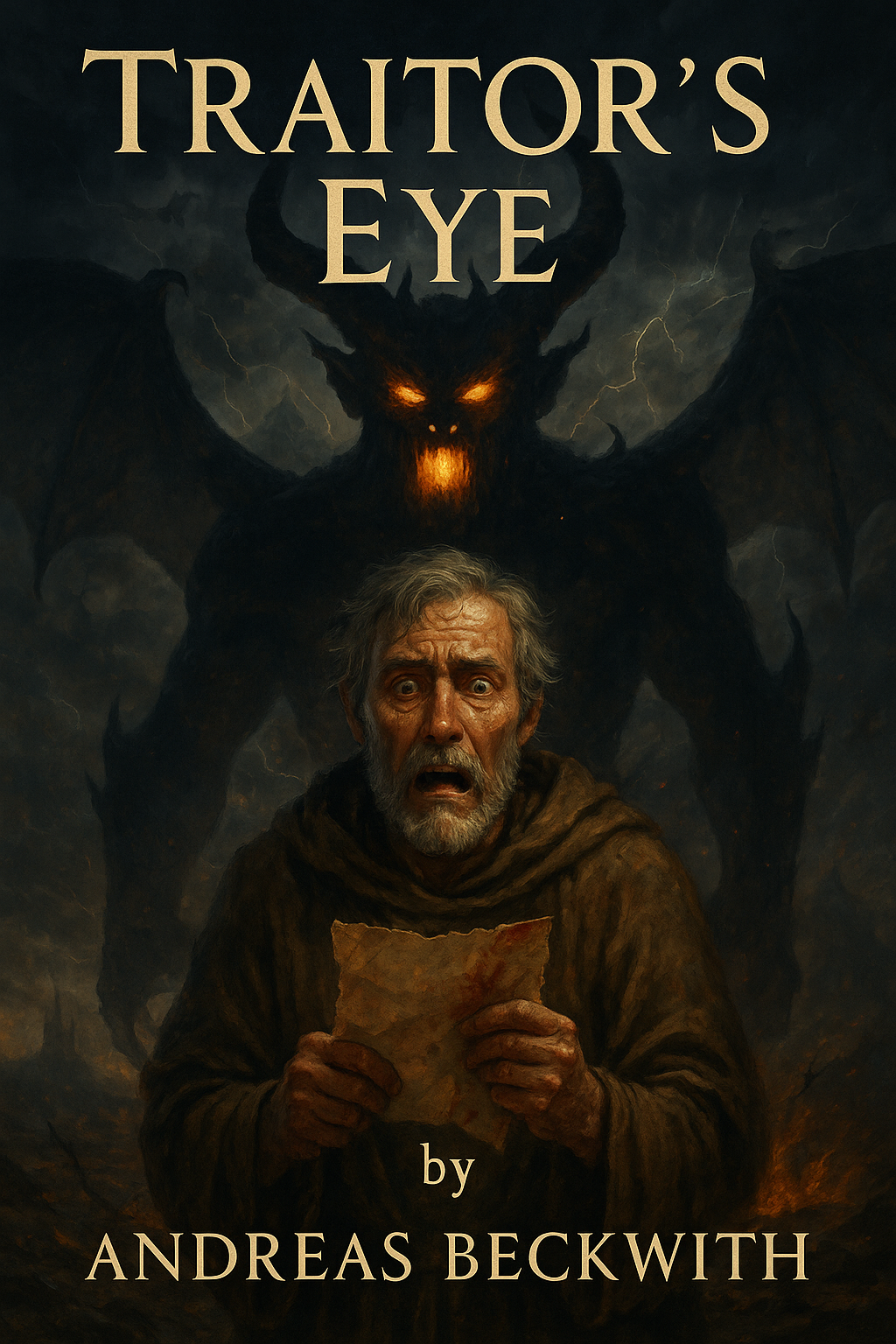
This is the key premise of the story of Traitor’s Eye, the question asked and one that needs an answer. Here, Traitor’s Eye connects with the Giant Dynasty, when Kelorne discovers an old book, Olaf’s chronicle of Felim’s reign that sets off thoughts and questions in Kelorne’s mind, and these thoughts, these questions, these doubts are the fuel for the plot of Traitor’s Eye.